
PRIMARY CARE
Morecambe Bay
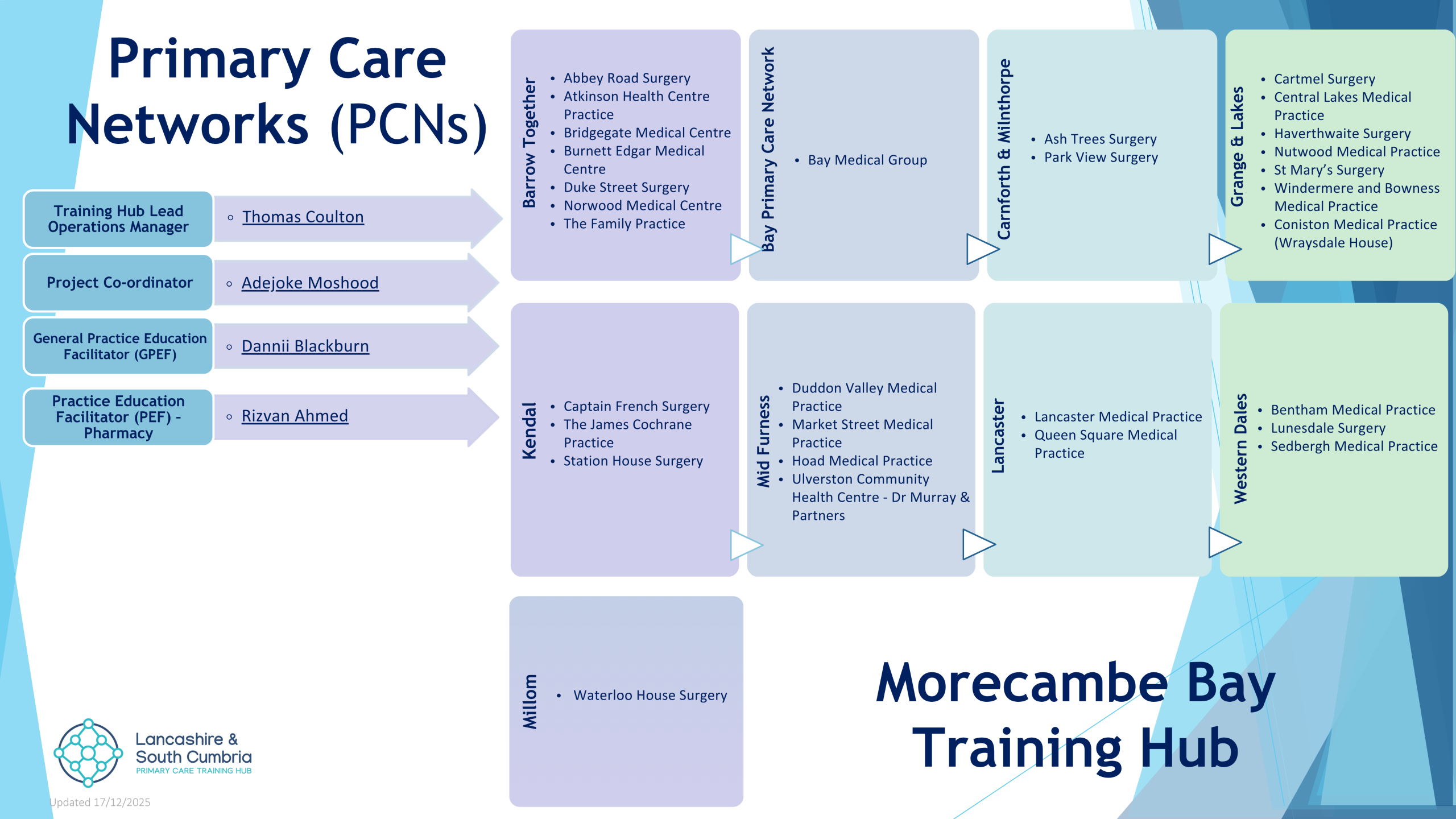
Morecambe Bay Primary Care Training Hub works with and on behalf of the 31 practices within the Morecambe Bay ICB footprint, which covers the Furness Peninsula, South Cumbria and North Lancashire.
We work in close cooperation with the Lancashire and South Cumbria Training Hub team as well as the other locality teams in the region to deliver locally and regionally commissioned educational and development programmes. You can read more about them in the Education section of this website.






WHAT'S HAPPENING ACROSS MORECAMBE BAY?
Trainings & Offers
Student Support
Student Placements in Primary Care
Hosting learners is a great way to promote Primary Care as a career and support the future workforce.
More InformationPractices/PCNs can opt to accommodate a variety of learners including Nursing, Paramedic, Pharmacy or Physician Associates. Placements are in set blocks during which students are expected to work with the MDT to experience what Primary Care is really like. Support available from the Training Hub ranges from learning environment accreditations, supervisor/assessor training, induction / timetabling support to any on placement queries. Practice payment available of £150 per week (Nursing/Paramedic/Pharmacy) or £555 per week (Physician Associate). | For more information Contact Dannii (GPEF) via [email protected]
Preceptorship programme for newly qualified Nurses/AHPs
Is your Practice/PCN recruiting newly qualified staff - if so our Preceptorship programme may be for you
More InformationReceiving the gold standard quality mark in 2024, our Preceptorship programme is specifically designed for newly qualified Nurses/AHPs to support their transition into Primary Care. Duration is between 2m-12m and preceptees benefit from the allocation of a dedicated and trained Preceptor to support them through the programme which ranges from induction support, CPD support as well as a focus on acquiring Primary Care specific skills - for more information, please contact our Preceptorship Lead - [email protected]
Apply HereZoladex Training for Primary Care staff hosted on MS Teams. This training session is hosted by Joan Millar from Astrazeneca. We offer a 30 minute MS teams session (12:30-13:00) which comprises the following- Prostate Cancer and LHRHa overview 5 mins Implant Demonstration – using a ‘dummy tummy ’20 mins Considerations and questions 5 mins Close
Book HereMorecambe Bay CPD 26/27
The following opportunities have been commissioned via NHSE CP monies and are free to access for General practice Nurses and eligible AHP groups. All training offers are in line with local workforce needs and have received prior approval from PCN Clinical Directors.
MRG Training for Medical Professionals
Cervical Sample Takers Course
6th-7th October 2026
More InformationThinking about training as a cervical sample taker? Applications are now open for our fully funded Cervical Sample Takers Course. Expert-led training ✔ Lunch & refreshments provided ✔ Essential CPD for new sample takers
Apply HereObesity is a growing healthcare problem affecting around 1 in 4 adults in the UK. Living with obesity can have a significant impact on physical and emotional wellbeing. Losing weight can be challenging and lost weight usually returns. There is no quick fix, and one approach does not fit all. Support is available both on the NHS and privately and includes drugs, surgery, nutritional plans and psychological interventions. The weight loss industry is big business with billions of pounds being spent each year. Weight loss jabs have surged in popularity and accessibility and the wrap around care required is new and evolving. This study day will be an interactive and relaxed day exploring the big picture, the NHS Long Term Plan and our role as Primary Care healthcare professionals working in the NHS. At the end of the day delegates will: Understand the importance of obesity and its impact on physical and emotional wellbeing Understand the multifactorial causes of obesity and how these can be modified to lose and maintain a healthy weight Gain an appreciation of the current national and NHS environment regarding weight loss jab management (both the strengths and weaknesses) Experience a practical approach to having difficult conversations about weight and expectations about management
Apply HereWe set the national scene and clarify the diagnosis of heart failure which interestingly is not the underlying diagnosis! We move on to the pathophysiology of heart failure with a 'sad story' which recounts the reactions from the body when the heart fails and lays out the systems which are involved in the body. This story then becomes the basis of understanding for the management of heart failure from the routine to the complex, where a "daddy dancing" approach to understanding biventricular pacing comes in handy. Keeping us focused on real life general practice, we round off the day with some clinical cases to discuss the obscure and to consolidate the learning. At the end of the day you will understand: The practice population at risk of developing heart failure The impact of heart failure on the individual and wider practice population The importance of effective management for those with heart failure The benefits and monitoring of pharmacological interventions available for treatment The rationale behind the current clinical guidelines for the diagnosis and management of heart failure in primary care
Apply HereAn online and interactive 2 days session by M&K Update focusing on Understanding Blood Results in Primary Care.
Apply HereWe set the national and individual impact of CKD into perspective. The role of the tests for CKD are immortalised in the "TV style kidney chef" production where we turn blood into urine in front of your very eyes! The latest NICE Guidance for CKD is covered, so from diagnosis to the appropriate management principles for CKD in primary care is explained, with the very important aspect of when to refer included. Avoiding acute kidney injury (AKI) is a vital aspect of primary care management of hypertension, CKD and simply the elderly population. This study day demystifies this and offers practical solutions. The day is relaxed and interactive using demonstrations, case studies and totally focused on what people working in general practice need to know and do about kidneys. At the end of the day you will understand: The importance of CKD & relevance in prevention of CVD The benefits and limitations of testing renal function The function of the normal kidney & what goes wrong in CKD The rationale behind national clinical guidelines for the management of CKD
Apply HereWe briefly set out the national scene and clarify the need for the effective management of hypertension. Moving on swiftly to the diagnosis of hypertension and the more recent approach to the use of ambulatory and home monitoring, with the roles of team members laid bare. The physiology of the normal management of blood pressure is explained with a building story on the wall. This is then the basis for explaining the causes and management of hypertension, facilitating discussion and to support the understanding of the way BP drugs affect the system, the side effects and the reasons for the selection of particular drugs. Once diagnosed and the appropriate treatment and up titration selected, according to the NICE Guidelines, monitoring and targets are the issue. AKI is a potential especially in the older patient, so the cause and prevention of this is explained in an interactive manner. Complicated and rarer causes of hypertension are outlined, and then clinical cases help consolidate the knowledge. At the end of the day delegates will: Understand the importance of hypertension and relevance in prevention of CVD Understand the principles of diagnosis and management in Primary Care and the team’s roles Understand the rationale behind the National Clinical Guidelines for the management of hypertension in patients in Primary Care
Apply HereFlexible course offerings across all of PITstop Diabetes programmes, including Foundation and Advanced level as well as updates where appropriate
Apply HereThe day also explains the reasons why venous ulcers occur and the specific factors, which influence their development. This is an interactive workshop. The outcomes of the workshop are to enable participants to; Understand the related Anatomy and physiology of leg ulcer formation Understand the pathophysiology and differentiation of Venous and Arterial Leg ulcers Critically appraise leg ulcer assessment strategies and tools Explore the legal, professional, policy and ethical dimensions in leg ulcer management Discuss holistic factors which may impact on healing, concordance and to prevent recurrence Use an Evidence based approach to Diagnostic tools and application of Compression Therapy within scope of professional practice. Introductions and objectives Anatomy and Physiology of the skin – Pathophysiology - Leg ulcer formation How to assess a leg ulcer – Strategies and Tools Treatment regimes Case Studies – using the evidence Doppler Ultrasound Technique – Finding Pedal Pulses Bandaging (The session will cover theory, include a practical demonstration of compression, and provide a guide to hosiery options (as covered in the leg ulcer day). Participants may practise bandaging on each other if materials are available. Please note, this does not confer competency — assessment must be carried out within your own organisation and applies to RNs and Nurse Associates only.
Apply HereThe aim of the day is for healthcare practitioners to acquire knowledge of CDH, stroke and TIA so they have the confidence to care for people with these conditions effectively in Primary Care. We start with the importance of CVD, who is at risk and how it can be prevented. This will include lipid lowering in primary care. We go on to consider CHD in more detail. How the heart works and how it helps itself during episode of angina. We explain the differences between stable angina and acute coronary syndromes and how these conditions present in primary care. Using clinical cases, we discuss making the diagnosis of CHD and the role of lifestyle choices, medication and revascularisation in controlling symptoms and increasing life expectancy. After lunch we move on to consider the diagnosis and management of stroke and TIA. Meet the dancing heart and the clotting chef to understand the importance of the diagnosis of atrial fibrillation (AF) and the role of anticoagulation in preventing embolic stroke. Throughout the day we will refer to current National Guidelines and pathways (NICE). At the end of the day delegates will have an appreciation of: The importance of CVD and who is most at risk The diagnosis and management of stable angina and unstable CAD The diagnosis and management of stroke & TIA The importance of diagnosis and role of anticoagulation in stroke prevention for people with AF
Apply HereFlexible course offerings across a range of Immunisation & Vaccination training include Foundation level, Annual updates as well as Flu, B12 and travel health updates
Apply HereFeedback
Events
This one hour webinar will be delivered by GP Catherine Munro and will cover a bit of background to testosterone in menopause and perimenopause, the complexities of libido and approaches to management, the role of testosterone as part of hormone replacement therapy, the indications for treatment, treatment options and safe prescribing, including monitoring and follow up.
Book hereAre you a Non-Medical Prescriber working in practice? Join our NMP Lunch & Learn webinar series—regular, bite-sized sessions designed to support your prescribing practice, expand your knowledge, and connect you with peers.
Join HereThis workshop is for all supervisors, assessors and Educators who support pre-registration learners, Allied Health Professional, Physician Associates, General Practitioners, NMC Assessors and Supervisors.
Register HereImproving Service Questionnaire
We’re keen to hear from anyone who uses Lancashire and South Cumbria Primary Care Training Hub services.
This short questionnaire is a quick and easy way to share your feedback—helping us understand what’s working well and where we can improve.