PRIMARY CARE

Clinical Roles

On this page you will find a range of clinical roles found within primary care and related resources and toolkits.

Advanced Clinical Practicitioner (ACP)

Advanced clinical practitioners (ACP) come from a range of professional backgrounds such as nursing, pharmacy, paramedics’ physiotherapy, and occupational therapy. They are healthcare professionals educated to Master’s Level and have developed the skills and knowledge to allow them to take on expanded roles and scope of practice caring for patients.

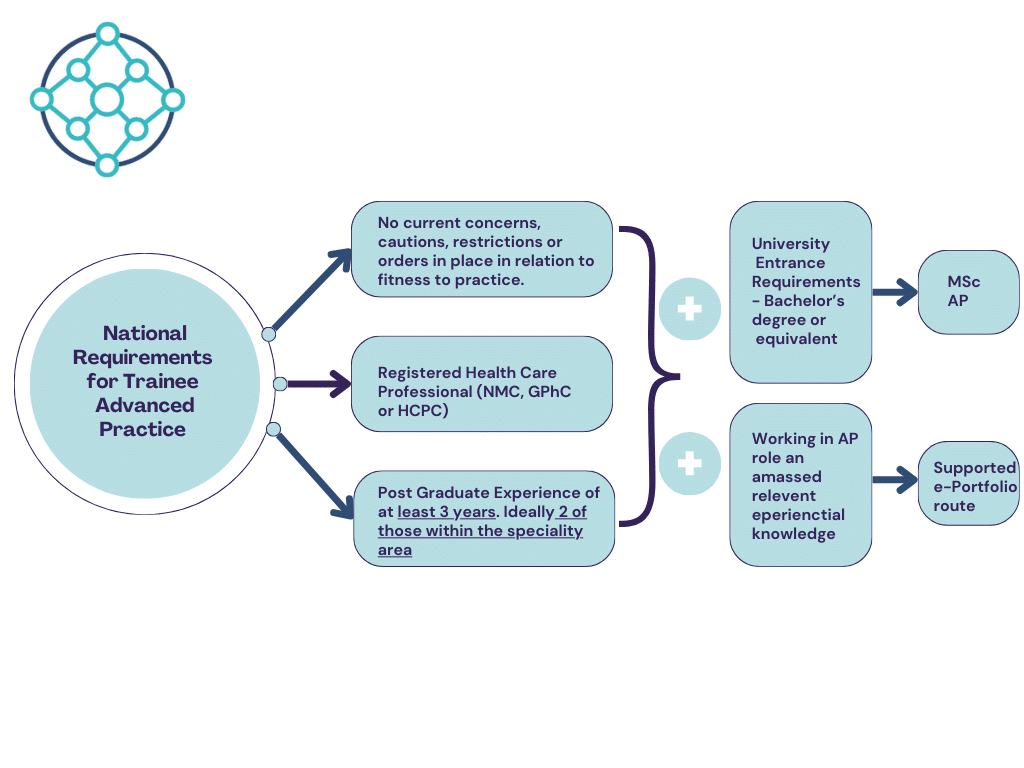
View the full image here: National Requirement for ACP

Who is/can become an Advanced Practitioner?

  • Allied Health Professionals
  • Nurses and Midwives
  • Pharmacists
  • Health Care Sciences

Physician Associates (PA):

PAs who are only working as GMC-regulated PAs cannot enrol on an AP course as they are not employed in a role with the autonomy of practice to undertake AP training.  They would need to have both maintained their previous regulation as nurses/AHPs etc with another statutory regulator and have returned to a suitable autonomous role within that previous profession in order to be eligible for funding support for AP education & training.

Requirements:

  • confirmation that the PAs have maintained their previous regulation as a nurse/AHP
  • are/will be employed in a role as a nurse/AHP prior to commencement/application to the HEI for their Masters course as a trainee ACP.

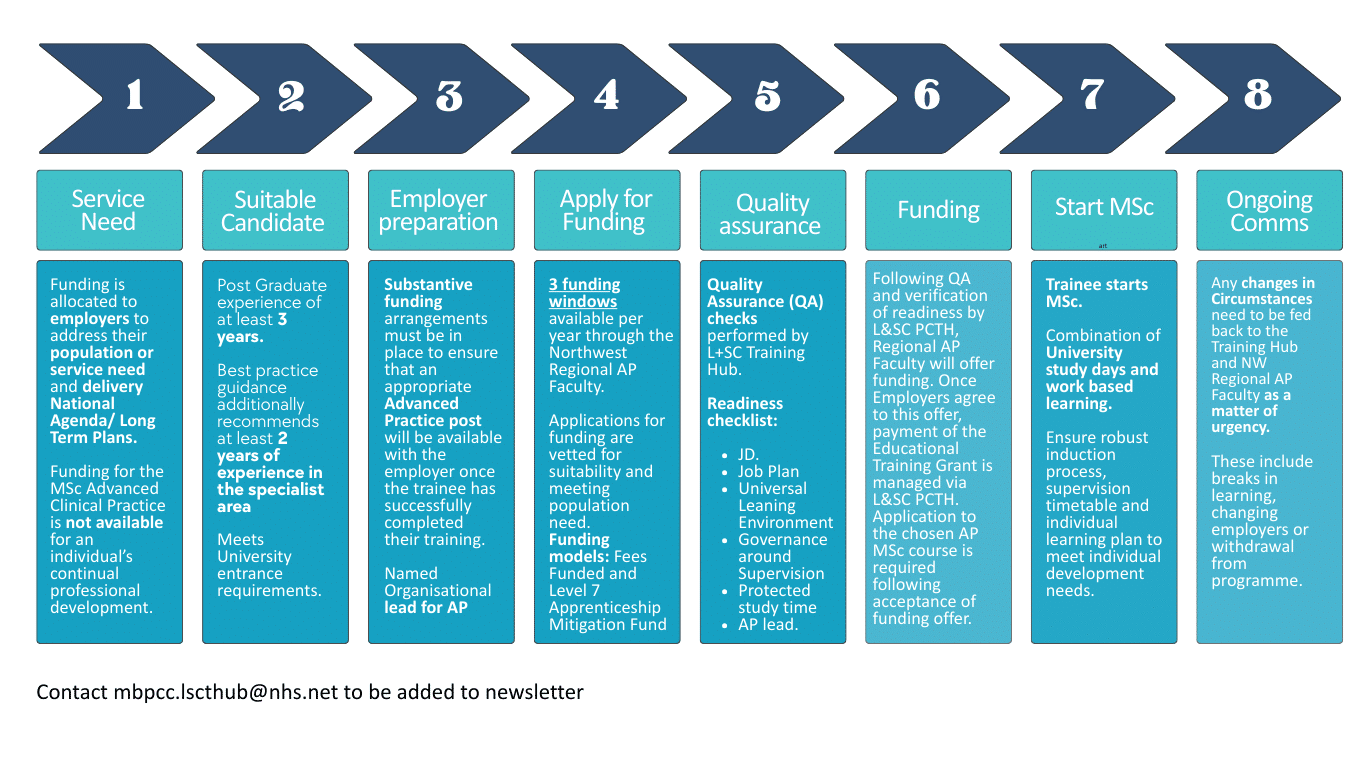
North-West AP Funding Page

Monthly NW Faculty Updates

The ePortfolio (Supported) Route provides formal recognition for experienced practitioners who:

  • are currently working in advanced practice roles and have built up experiential knowledge equivalent to that of an MSc.
  • completed their Masters before 2017 or through a non-accredited programme.

Although voluntary, completing this route demonstrates professional commitment and supports national recognition of advanced practice.

Why Choose This Route?

The ePortfolio (Supported) Route offers a structured, quality-assured process to:

If you completed an accredited MSc after 2017, you may instead be eligible for recognition through an accredited programme.

How to Get Started

Review the eligibility criteria, obtain support from your employer or training provider, and submit an Expression of Interest (EOI).

Please note: Due to high demand, there may be a waiting period before you can begin. If you have already submitted an EOI, you do not need to submit another unless your details have changed.

Associate Psychological Practitioner (APP)

“The ‘Associate Psychological Practitioner’ (APP) is an innovative new role that expands the psychological workforce and addresses the rising demand for mental health services in England.”
ULan

Dietitian

Dietitians have a huge role to play in primary and community care settings. Hear about the timely and sustainable positive patient impact that new roles have had in dietetic care pathways, People see the right person in the right place, first time

General Practitioner (GP)

General practitioners have an important role in looking after patients in their homes and within the communities where they live. They are part of a much wider team whose role includes promoting, preventing and initiating treatment.

 
Request for GPs to complete. This survey is for all GPs, if you have a GPwSI role, and also for any GPs who would want to develop into this area.
This is to help inform the ICB primary Care team the landscape for current and future GPwSI provision.
Please could all GPs take a couple of minutes to complete the survey, even if this is not an area you wish to develop in further. as you may have some education and training that you utilise to support your practice/PCN in terms of specialism.

The scheme is aimed at doctors who are seriously considering leaving or have left general practice due to personal reasons (caring responsibilities or personal illness), approaching retirement or requiring greater flexibility. 

This programme is open to all new to practice GPs employed within general practice or a PCN within Lancashire and South Cumbria.
GPs must have qualified and commenced their role within the last 24 months to be eligible to apply for this programme.
Successful applicants will have access to six mentoring / coaching sessions with highly qualified and experienced mentors over a 12-
month period.
The programme will be delivered digitally, allowing coaching sessions to take place anywhere across Lancashire and South Cumbria.
 
To apply to take part in this programme please see flyer Mentorship for new to primary care GPs and complete the following form
or for more information or any queries, please contact [email protected]
The programme is about empowering a new generation of leaders in primary care, equipping them with the skills and networks to succeed and empowering them with the belief that they can translate insight into impact. 
Find out more on our Next Gen page.

Observe GP is an alternative to work experience for aspiring medics aged 16 and over, who are living in the UK. It is a free interactive video platform providing insights into the role of a GP and the wider primary care team.


General Practice Assistant (GPA)

As part of the wider team in general practice, General Practice Assistants provide a support role, carrying out administrative tasks, combined in some areas with basic clinical duties. They can help to free up GPs time and contribute to the smooth running of appointments, improving patients experience in the surgery. They are healthcare professionals educated to Master’s Level and have developed the skills and knowledge to allow them to take on expanded roles and scope of practice caring for patients.


The recent Level 4 training offer for GPAs has now closed and NHS England are currently undertaking a procurement exercise for course for 2026. It is anticipated that courses will become available from Autumn 2026.

In the meantime, where practices and PCNs have a GPA who wishes to complete the course, we strongly recommend you submit an EOI via this link so there is an accurate reflection of demand for places.

This will also give you first refusal of a place when courses become available. 

NHS England GP Assistant Accredited Education Course – Expression of Interest


Health Care Support Worker

The term healthcare support worker (HCSW) is an umbrella term which covers a variety of health and care support roles, including healthcare assistant (HCA), nursing assistant, and more.

Find out more about the healthcare support worker programme on NHSE’s website.

Health Education England, Skills for Care and Skills for Health have worked together to develop the Care Certificate. The Certificate has been designed to meet the requirements set out in the Cavendish Review.

E-Learning
The e-learning is free to access for health and care professionals. For more information about the e-learning programme, including how to access, visit:  https://www.e-lfh.org.uk/programmes/care-certificate/

There are various apprenticeships created for;

  • Those currently in non-clinical roles wanting to progress in to a care support role, or those new to/in a care support role, wanting to gain new knowledge, skills and qualifications for development (such as the Health Care Support Worker or Adult Care Worker apprenticeships). 
  • Those with clinical experience and the opportunity and desire to support colleagues and progress in to a senior role (such as the Senior Healthcare Support Worker or Lead Adult Care Worker apprenticeships).

For more information see our apprenticeship page.


Mental Health Practitioner

Providing high quality mental health care in a less stigmatising environment at the right time, reducing adverse outcomes for those suffering from mental health problems and providing consistency of care for those individuals transitioning between services.


Nursing Associate (NA)

The Nursing Associate (NA) role is now an established and regulated part of the nursing workforce in England. It was introduced to bridge the gap between health care support workers and registered nurses. RCN.org.uk

Occupational Therapist (OT)

Occupational therapy helps you live your best life at home, at work – and everywhere else.

It’s about being able to do the things you want and have to do. That could mean helping you overcome challenges learning at school, going to work, playing sport or simply doing the dishes.

Everything is focused on your wellbeing and your ability to participate in activities. It’s also a science-based, health and social care profession that’s regulated by the Health and Care Professions Council.

Visit the Royal College of Occupational Therapists website here.

Paramedic

Paramedics in primary care work directly in GP surgeries and local health centres. They evaluate urgent, same-day illnesses and injuries, handle telephone assessments, and perform home visits. Their role helps ease doctor workloads and ensures patients are seen quickly by a medical professional.

Pharmacy Professionals

Clinical pharmacists are increasingly working as part of general practice teams. They are highly qualified experts in medicines and can help people in a range of ways. This includes carrying out structured medication reviews for patients with ongoing health problems and improving patient safety, outcomes and value through a person-centred approach (NHSE).

From autumn 2026, a national NHS Independent Prescribing (IP) offer will be introduced as an extension of Pharmacy First and the pharmacy contraception service.

This will include:

  • Prescribing within existing Pharmacy First clinical pathways and the pharmacy contraception service
  • Up to 5 new prescribing-only pathways subject to assessment by a clinical reference group
  • Appropriate circumstances for prescription management

Lancashire and South Cumbria (LSC) ICB are working in collaboration with LSC PCTH to provide the 2026 “Teach & Treat” programme, to increase the number of community pharmacist IPs.

They are inviting Expressions of Interest from Community Pharmacists in LSC who would like to undertake their IP qualification over the next few months. An opportunity is available to do this with the support of the Teach and Treat programme.

The programme involves support with the following:

  • Finding a DPP
  • IP applications
  • Identifying an IP course provider
  • Free access to “Lunch and Learn” training sessions for NMPs and trainees
  • Community of Practice

IP course fees continue to be funded by NHSE Workforce, Training and Education.

Please complete this form to express your interest in being part of this programme.

Rizvan Ahmed
Pharmacy Practice Education Facilitator

PA

PAs are healthcare professionals who work as part of a multidisciplinary team under the supervision of a named senior doctor (a General Medical Council (GMC)-registered consultant or GP). While they are not medical doctors, PAs can assess, diagnose, and treat patients in primary, secondary and community care environments within their scope of practice.

For more information on the PA role from NHSE click here

To qualify as a PA in the UK, students must complete either:

A postgraduate (level 7, ie a masters level) degree in Physician Associate studies OR Integrated undergraduate masters degree, this is currently offered at UCLan and is the first of its kind in the UK

Both programmes consist of theoretical learning in medical sciences, pharmacology, clinical reasoning, as well as clinical placement experience. To enter post graduate PA training, individuals must be either an existing registered healthcare professional or a graduate with a biomedical science or biological/life science degree.

All programmes in the UK are run in accordance with the Competency and Curriculum Framework developed by the Department of Health and Social Care (DHSC), the Royal College of Physicians (RCP) and the Royal College of General Practitioners. Once they have completed a PA degree programme, all candidates must pass the PA National Examination, which is delivered by the RCP Assessment Unit, to be able to register as a PA in the UK.


Amy Howarth
Physician Associate Clinical Lead
[email protected]

Physiotherapist

Physiotherapists in general practice are experts in musculoskeletal conditions. They are able to assess, diagnose and treat a range of complex muscle and joint conditions preventing the need for referrals to hospital. They can arrange swift access to further treatment, investigations and specialists when needed.

Personalised Care

Personalised care represents a new relationship between people, professionals and the system. It happens when we make the most of the expertise, capacity and potential of people, families and communities. NHSE.

Social prescribing link workers connect people with local community activities and services that can help.

Find out more about the role on the NHS Health Careers website.

If you have any questions please email [email protected]

Health coaching is a patient-centred process that is based upon behaviour change theory and is delivered by health professionals with diverse backgrounds.

Care coordinators provide extra time, capacity, and expertise to support patients in preparing for clinical conversations or in following up discussions with primary care professionals. They focus on the delivery of personalised care to reflect local PCN priorities, health inequalities or at risk groups of patients. They can also support PCNs in the delivery of Enhanced Health in Care Homes.