PROGRAMMES
Placements
General Practice is particularly suited to supporting the development of healthcare learners due to the wide range of learning opportunities and types of patient contact that take place in this clinical setting.
It is also a great setting to support the development of staff and provide opportunities to upskill through many programmes.
Award Nominations

Virtual Placement in Primary Care
We are delighted to inform you that we were shortlisted for our Primary Care clinical Virtual Placement in the Nursing Times Workforce Summit and Awards 2025.
Lancashire & South Cumbria Primary Care Training Hub (L&SC PCTH) in partnership with University of Cumbria, University of Lancashire, and healthcare professionals launched the first innovative primary care virtual placement.
This placement supported Pre-registration nursing learners, fostering interprofessional collaboration, shared understanding and enhanced knowledge of primary care. Thus allowing the learners to gain an insight into patient perspectives, services available, and compassionate person-centred care.
Life Journey Pathway Placement
We are delighted to inform you that we have been shortlisted for the Life Journey Pathway Placement in the Nursing Times Awards 2024 in the category of Nursing in Primary Care.
Life Journey Pathway (CPEP project) is a unique and innovative placement encompassing a ‘Person’s Life Journey through Health and Social Care’, underpinning the journey from birth to death.
The project was developed in partnership with Lancashire and South Cumbria Primary Care Training Hub
(LSC PCTH), Social Care, HCRG Care Group, Learner Quality Ambassadors, Service User Representatives,
Edge Hill University, University of Central Lancashire, University of Bolton, University of Cumbria and has
been facilitated in various practices and Nursing Homes across Lancashire and South Cumbria.
Learners
Apprenticeship Placements
There is a requirement that proficiencies and learning outcomes will be completed by external placements; including short-spoke, and long-spoke placements. Your GPEFs will work in partnership with external organisations to secure your long-spoke placements, it is, therefore, essential these are arranged via the GPEF, therefore, please DO NOT contact the organisations yourselves
To contact please see meet our GPEFs below.
What's happening
Placements
A Person’s Life Journey Pathway through Health and Social Care
This placement has been developed in partnership with Primary Care, Social Care, Student Quality Ambassadors, Patient Representatives, Edge Hill University, University of Central Lancashire, and University of Cumbria for Pre-Registration Nurses.
This placement is a unique and innovative experience for learners to follow a ‘real life’ case study of a person/family’s journey within Health and Social Care, underpinning the journey from birth to death. The learner experience will include allocated time within 3 organisations, which allows the learner to gain a holistic overview of the person, the care they receive and the services they access across their life journey, this will develop a holistic approach to a person/family’s health and well-being alongside developing skills, knowledge, and experience within the learner’s programme of study.
See the A ‘Real-Life’ Case Study Flyer here.
Hub and Spoke Placements
These placements are for learners who are allocated to a main placement area (hub) where they will spend the majority of their placement, but also visit associated placement areas (spoke) for shorter periods of time giving the learners the opportunity to gain experience in other settings.
Download the below PDF here.

Primary Care Virtual Placement
Lancashire & South Cumbria Primary Care Training Hub (L&SC PCTH) have developed an innovative and unique 2-week online/virtual placement. This placement supports learners across a range of healthcare disciplines, including pre-registration nursing (across all fields), physician associates, apprentices and medical learners. The placement fosters interprofessional collaboration, shared understanding and enhanced knowledge of Primary Care, allowing the learners to gain a holistic overview of a person, the care they receive and the services they access. The Primary Care Clinical Virtual Placement provides a structured framework for learners to explore a real person and their family’s journey through healthcare services. This placement is facilitated by our General Practice Education Facilitators (GPEFs) alongside a range of healthcare professionals. These sessions are designed to enhance learners’ understanding of Primary Care and its role within the wider healthcare system.
Standard Placements
Lancashire & South Cumbria Primary Care Training Hub (L&SC PCTH) have developed an innovative and unique 2-week online/virtual placement. This placement supports learners across a range of healthcare disciplines, including pre-registration nursing (across all fields), physician associates, apprentices and medical learners. The placement fosters interprofessional collaboration, shared understanding and enhanced knowledge of Primary Care, allowing the learners to gain a holistic overview of a person, the care they receive and the services they access. The Primary Care Clinical Virtual Placement provides a structured framework for learners to explore a real person and their family’s journey through healthcare services. This placement is facilitated by our General Practice Education Facilitators (GPEFs) alongside a range of healthcare professionals. These sessions are designed to enhance learners’ understanding of Primary Care and its role within the wider healthcare system.

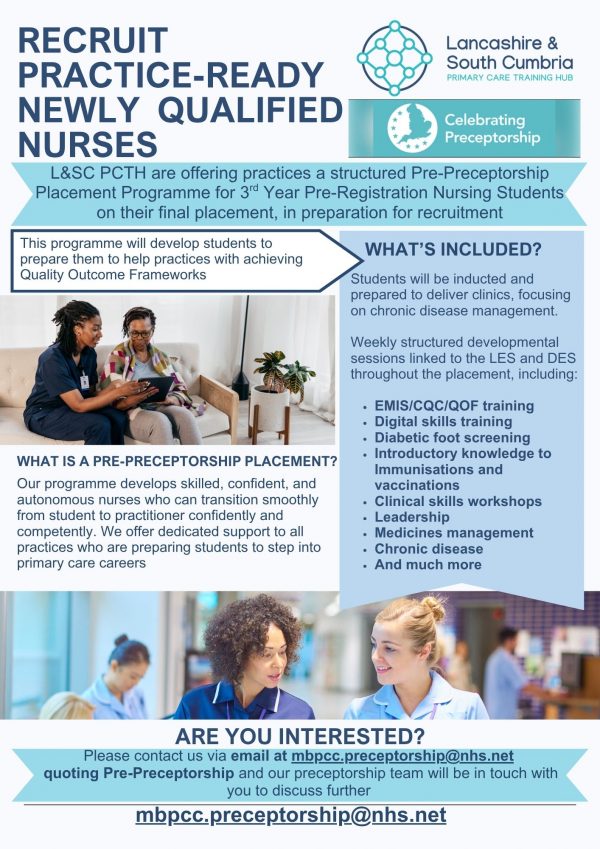
3rd Year Pre-Preceptorship Placement
Pre Preceptorship Programme Aims :
- Develop skills and confidence to become a autonomous practitioner alongside building clinical skills required to fulfil the general practice nurse role
- Provide a period of preparation to ease the transition from learner to registered Health Care Professional, improving readiness for employment within primary care
- Improve understanding of the healthcare system and the business needs of the practice
- Builds on skills and experiences acquired through reflection
What is Included?
Learners will be prepared with the knowledge and skills to enable them to deliver a clinic focused on chronic disease management to help achieve the Quality Outcomes Framework. Weekly structured sessions linked to the Local Enhanced Service (LES) and the Directed Enhanced Service) DES are included throughout the placement such as:
What is included?
- EMIS Training
- Diabetic Foot Screening Training
- Venepuncture Training
- NHS Health Checks
- Application form Support
- Interview Skills
- Introduction to
- Respiratory
- FeNO Training
- Spirometry
- Making Every Contact Count (MECC)
- Talk Cancer Workshop
- Leadership Skills
- Chronic Disease Management
- Asthma
- COPD
- Diabetes
- Wound Care
- Clinical Skills Workshop
- Consultation Skills
- Access to our two week Primary Care Virtual Placement
- Health and Wellbeing
How is this Delivered?
Learners will join your practice in the usual way for their clinical placement, gaining valuable hands-on experience within your team.
As part of their programme, one day each week will be dedicated to developmental learning. On this day, learners will follow a structured timetable of activities — either completing online learning from home or attending face-to-face education sessions at a designated venue.
This approach allows learners to balance practical experience with focused professional development, ensuring they gain the skills, confidence, and knowledge to become capable autonomous practitioners.
Interprofessional Learning model
The Interprofessional Placement Model is a placement model, introduced by the Lancashire and South Cumbria Primary Care Training Hub, adapted the fantastic work in Northumberland to incorporate other learner types into the structure, creating a standardized approach to learning within practice. There is also an additional benefit of shared learning across different educational pathways and the nurturing of professional respect for other roles within healthcare.
Learner led clinics ensures learner development in several areas:
- Leadership & Management skills
- Clinical skills & professional respect
- Team working skills
- Decision making skills
- Communication Skills
This also supports the learner to feel part of the wider team whilst delivering a service to the local community.
Higher Education Institute Key Contacts
University of Lancashire Nursing Placement Key Contacts
University of Cumbria Nursing Placement Key Contacts
Edge Hill University Nursing Placement Key Contacts
University of Liverpool Nursing Placement Key Contacts
Testimonials
Laura Hodgkinson, Practice Manager, Duke Street Surgery
We offer 6 different placement models. Each model gives the learners the opportunity to experience a multidisciplinary team, working to expand their knowledge, the roles within the organisation, and how different roles interact in providing services to the local population. Placements give learners the chance to participate in extra settings which may have different specialisms or enhanced services; this allows the learners to develop their skills, confidence, and competencies more.
Safe Learning Environment Charter
The Safe Learning Environment Charter (SLEC) supports the development of positive safety cultures and continuous learning across all learning environments in the NHS. It is underpinned by principles of equality, diversity, and inclusion.
Click here to view and download the PDF posters, safe-learning-charter-themes-posters
Read More
The Charter is designed for learners and those responsible for supporting placement learning across all learning environments and all professions within them. It is aligned to the NHS People Promise in recognition that learners are vital to the workforce and are included in the promises we must all make to each other, to improve everyone’s experience of working in the NHS. The Charter sets out the supportive learning environment required to allow learners to become well-rounded professionals with the right skills and knowledge to provide safe and compassionate care of the highest quality.
For more information please visit NHS England » Safe Learning Environment Charter – what good looks like
PARE and ULE Update
Read More
This means that learning environments will be approved for any learner (except medical students), as long as the environment can demonstrate they:
- Have the appropriate Educator(s)
- Can cover the curriculum requirements of each learner
- Have sufficient capacity
- Meet quality standards set by Regulators and/or NHS England
The ULE process is a National Health Service England (NHSE) programme supported by our regulatory bodies GMC/NMC/HCPC. Organisations can apply for approval as a single provider, such as a GP Practice, or a multi-provider, such as a PCN or Federation.
Moving forward, the ULE process will be administrated by the ICS Training Hubs and reviews will take place in a virtual format. The National Education Contract is signed by the ICS Training Hub for primary care placements. The quality assurance of this process will be undertaken via the NHSE NW Primary Care School.
PARE (Practice Assessment Record & Evaluation) was developed by Health Education England (now part of NHS England) and the University of Chester. PARE will host a digital Learning Environment Approval Audit, automating a pre-agreed process for the approval of new Learning Environments across the region and delegating the various stages of the process to the correct stakeholders. PARE will also act as a database to host relevant information regarding NW GP Practices (for example whether they are currently a training practice or not) and NW Educators (for example showing which professionals they are approved to supervise at which practice). Having oversight of environments and supervisors enables the NW Primary Care School and wider stakeholders to identify capacity and thus help to increase the number of available learning environments across the North West.
The ULE functionality within PARE will show which environments have been audited by the NWPEG audit (via the Higher Educational Institutes and Training Hubs) and which environments have been audited via the new Unified Learning Environment (ULE) process. As of 10th October 2023, all new environment approvals/audits in primary care will be reviewed and ratified in electronic format via the PARE system.
To prepare for the move to the ULE process and to PARE, the Primary Care School has completed a data cleansing exercise, a ULE pilot, and a beta test.
PLEASE NOTE the following:
- GP Practices only appear once on PARE and will be moved under a single organisation in PARE called ‘Primary Care School (North West)’
- Access will still be controlled – users will have access to specific placements, or relevant groups of placements, based on their access rights and the ‘tags’ being applied to each placement (PCN, Training Hub, PIVO and GP Training Programme)
- In instances where practices had multiple PR codes previously, these have now been amalgamated under one ODS code
- Existing PARE users will still (where applicable) be able to search on practice name to find placement information, however the ODS code can now also be used
- Information that was held in a separate area of PARE during the pilot and beta test phases will now be visible to all applicable users
- We have completed a thorough review of access rights for existing PARE users
- PARE FAQs were created – please find these attached – this includes information around how your account may differ moving forward and why some placements have been renamed and/or merged
If you have any queries regarding your access to, or placements on the PARE system, or regarding the ULE approval process, please contact your local Training Hub: [email protected]
See more information here:
Tariff Guidance
NHSE have produced a Tariff Guidance document for 26/27. Shareable guidance for providers in now available on the NHSE website here.
NHSE have advised this document aims to ‘demystify and summarise clinical tariff, how it works, how the funding works and case studies of how it’s being used’.
You can find all Learner Placements & Tariff information HERE.
*Funding for apprenticeships is not guaranteed for all future intakes, and we confirm available funding when we announce each intake.
For more information on Placements, please contact [email protected]
What's happening
Workshops and Training
Learning Environment Educator Development Workshops
We host monthly Learning Environment Educator Development update training sessions.
Click here for more information
Learning Environment Educator Development Information for NMC Assessors and Supervisors, Allied Health Professional Educators, Physician Associates, and General Practitioners who support Pre Registration learners.
Feedback
"The facilitators allowed open conversation and were able to discuss ""real world"" experiences and challenges from a perspective of having dealt with the issues in practice. Supportive and knowledgeable presenters."
Attendee - June 2023
"very good workshop, presenter were friendly and engaging."
Attendee - December 2022
Observe GP
Observe GP is an alternative to work experience for aspiring medics aged 16 and over, who are living in the UK. It is a free interactive video platform providing insights into the role of a GP and the wider primary care team.
Free Online Courses
Pre-Registration Nurse Attrition and Transition Knowledge Portal
The NHSE Team have developed a knowledge portal that provides links to key resources related to student attrition and transition, such as:
- Cost of Living Good Practice Guide
- Support for paused and returning students
- Articles on clinical placement supervision models
- Equality and diversity resources
The portal is housed via the Future NHS website accessible here.
Discovering a Career in General Practice Nursing (CNO 002)
Discovering a Career in General Practice Nursing (CNO 002) is a single module available to nurses or nursing associates, either qualified or in training, who are looking for a real kickstart to their career by providing information and insight into the role of a General Practice Nurse (University of Cumbria).
See flyer here.
See full details here: Discovering a Nursing Career UoC
Understanding the Role of General Practice Nursing
What's happening
Resources & Videos
Please find useful updates, information and resources below
Student Placement Information Webinar
We hosted the Student Placement Information Webinar on the 21st of April. If you missed it, please view the recording below:
Chief Nursing Officer and Chief Midwifery Officer Awards
The chief nursing officer (CNO) and chief midwifery officer (CMidO) awards have been developed to reward the significant and outstanding contribution made by student nurses and midwives in England and their exceptional contribution to nursing and midwifery practice. These are exciting new awards that mirror those for nurses, midwives, healthcare support workers and maternity support workers and recognise and reward the significant and outstanding contribution to nursing and midwifery practice by students.
For more information, as well as details for the criteria, eligibility, and process please follow This Link
Further Updates
Some Organisations have a playback function disabled so therefore needs to be taken up with their IT department or opened on a device not on the Organisations internet e.g., a separate mobile device with different WiFi.
North West Practice Education Group has been working on the development of an online presence to publicise the work completed and to provide a platform for the core work of the group – sharing best practice and supporting and sharing initiatives to improve quality.
The North West Practice Education Group site has launched with the first of a series of blogs promoting one of the projects which the group secured funding for, that is being led from the University of Salford – the NW educator project which will launch soon. This will provide a central development resource to support our practice partners in developing their skills to support our students… feed in into sustained CPD supported through the online network, this is supported by a YouTube channel which we can utilise to share webinar recordings.
This is a hub for student nurses, midwives and trainee nursing associate (TNA), designed in collaboration with students to help support you in your studies and journey into your healthcare career. Take a look around the hub to find out more about Health Education England (HEE) and what resources are available to help support and advise you.
Professional standards for educators and learners
General Practice Nursing Educational Resources
Diabetes Educational Resources for General Practice and Primary Care Nurses
it is vital that GPNs are up to date with information on diabetes and work with patients to maximise their health with health education and promotion.
Type 1 diabetes is an autoimmune condition where by the pancreas does not produce insulin and the treatment is always insulin. Multiple daily insulin injections are used by many but the used of insulin pumps and hybrid closed loop systems are increasing.
• Type 2 diabetes occurs due to insulin resistance and the insulin produced by the pancreas doesn’t work effectively. Over time insufficient insulin production may also occur. Type 2 diabetes accounts for around 10% of the annual NHS budget.
• Gestational diabetes (GDM) occurs during pregnancy and increases the risk of developing type 2 diabetes after pregnancy. Women with previous GDM should have annual HbA1c surveillance.
• Type 3c, MODY and Latent Autoimmune Diabetes in Adults (LADA) are less common types of diabetes but may still be seen in general practice.
Heart Failure Core Career and Capability Framework
Heart failure is the destination condition of most cardiovascular diseases.
An estimated 1 million people are living with heart failure in the UK. There are 200,000 new diagnoses each year with an estimated 400,000 cases currently undetected in UK.
80% of Heart Failure first diagnoses as made as emergency admissions to hospital, with several patients visiting their GPs with symptoms in the months before admission.
Menopause Educational Resources for General Practice nurses
The menopause usually affects women between the ages of 45 and 55, but it can happen earlier for reasons such as surgery to remove the ovaries or the uterus, or because of cancer treatments like chemotherapy.
Although each person will experience the menopause in a different way, three out of four people going through the menopause will experience symptoms, and for one in four, these will be severe and impact their day-to-day life.
Symptoms can last for several years and can include anxiety, low mood, hot flushes, difficulty concentrating, headaches, and insomnia.
Wound Care Educational Resources for Community and Primary Care Nurses
Wound care should not be viewed as a separate clinical issue but as an integral part of the holistic assessment, including optimisation of long-term conditions which cause or contribute to wounding and delayed/non-healing.
Failure to diagnose wound type, leads to potential delays in providing patients with appropriate evidence-based treatment pathways, which could result in delayed/non healing and/or secondary complications.
Affecting 1:11, asthma is the most common long-term condition in children and young people (CYP). It can be wrongly perceived as a mild disease, and research shows that it is often not taken seriously enough. Those with ‘mild asthma’ can deteriorate, causing increased morbidity and mortality.
Education for children and their families, clinicians and wider members of health care teams about recognising and managing triggers, symptoms and asthma attacks is key to effective asthma control.
Although some asthma attacks come on without warning, many build up slowly, over hours to days. This means that there is often a window of opportunity to treat them in primary care before symptoms escalate into an emergency.
Patients must be educated to understand their triggers and
how they can avoid or manage them.
Patients must know the signs of worsening asthma so they can get early help.
Cancer Educational Resources for General Practice and Primary Care Nurses
The NHS ambition in the Long -Term Plan is to diagnose 75% of cancers at stage I or II by 2028. Earlier diagnosis means cancers are easier to treat and result in better patient outcomes.
There are increasing numbers of people living with cancer in the United Kingdom due to increased survival and an ageing population.
There are 393,000 new cancer diagnosis each year, this is expected to be 500,000 annually by 2040.
Minor illness Core Career and Capability Framework
This accounts for a significant proportion of primary care presentations. Conditions such as coughs, colds, sore throats, ear infections, mild gastrointestinal issues, and skin complaints are among the most common reasons people seek primary care support.
An estimated 20–40% of GP consultations are related to minor illness. Many of these conditions are self-limiting and could be safely managed at home with appropriate self-care advice. However, minor illness still contributes to unnecessary demand on general practice and emergency departments, with millions of potentially avoidable appointments each year.

Meet Our Team
PLACEMENTS DEPARTMENT

Nicola Albanese
Programme Manager

Samantha Jefferies
Project Manager (Placements)
I am the Project Manager for Lancashire & South Cumbria Primary Care Training Hub, for Placements.
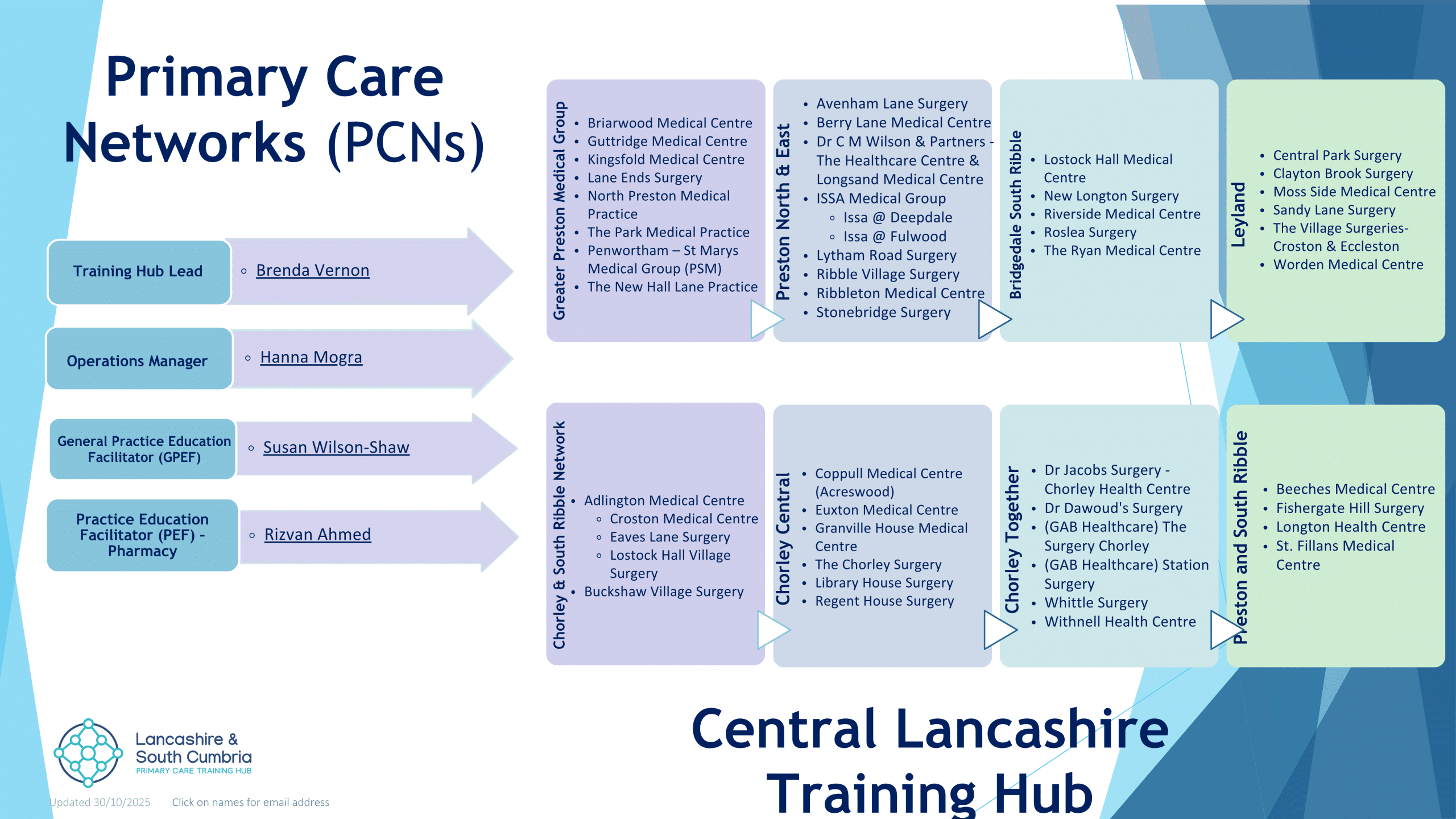
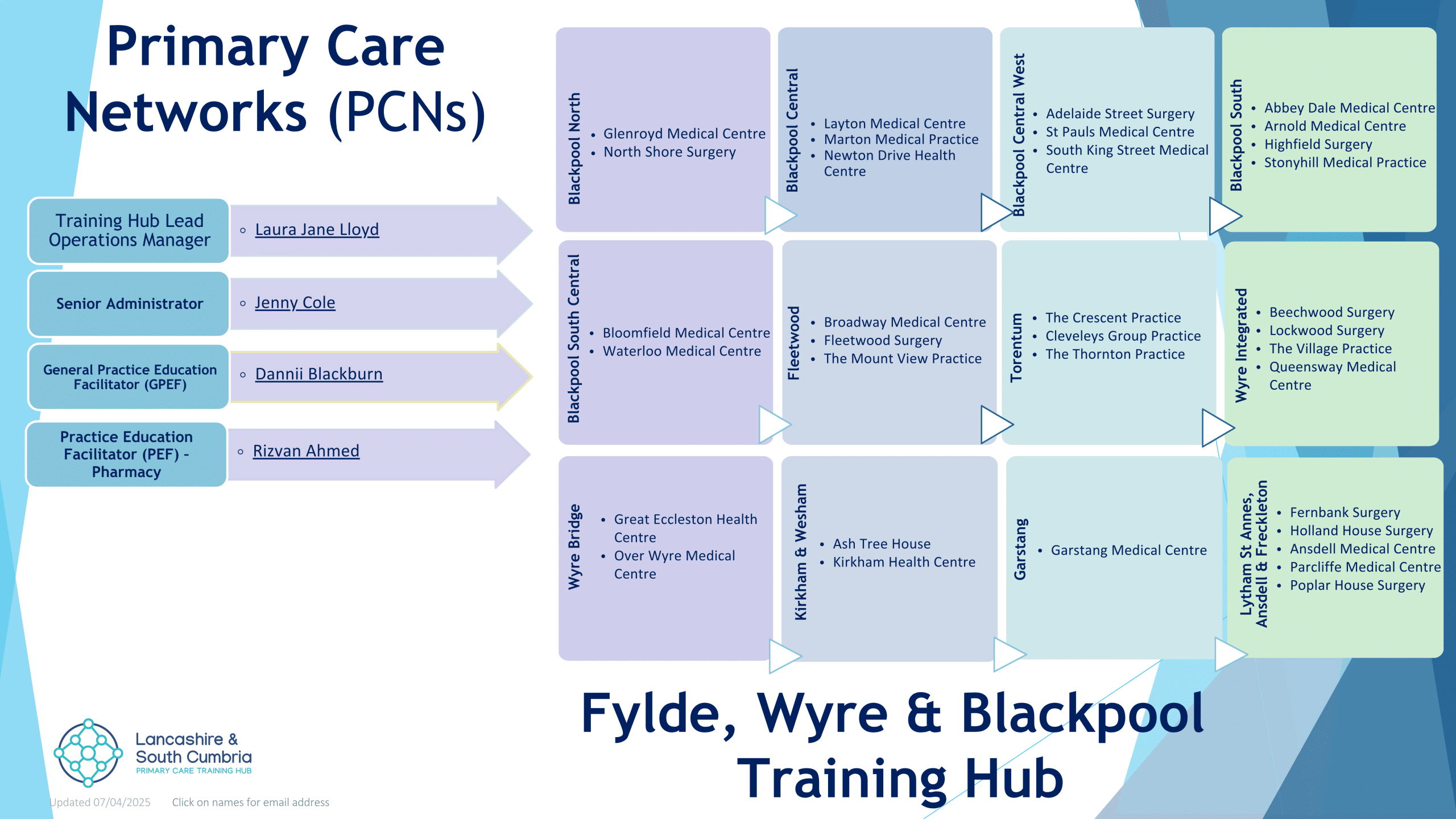
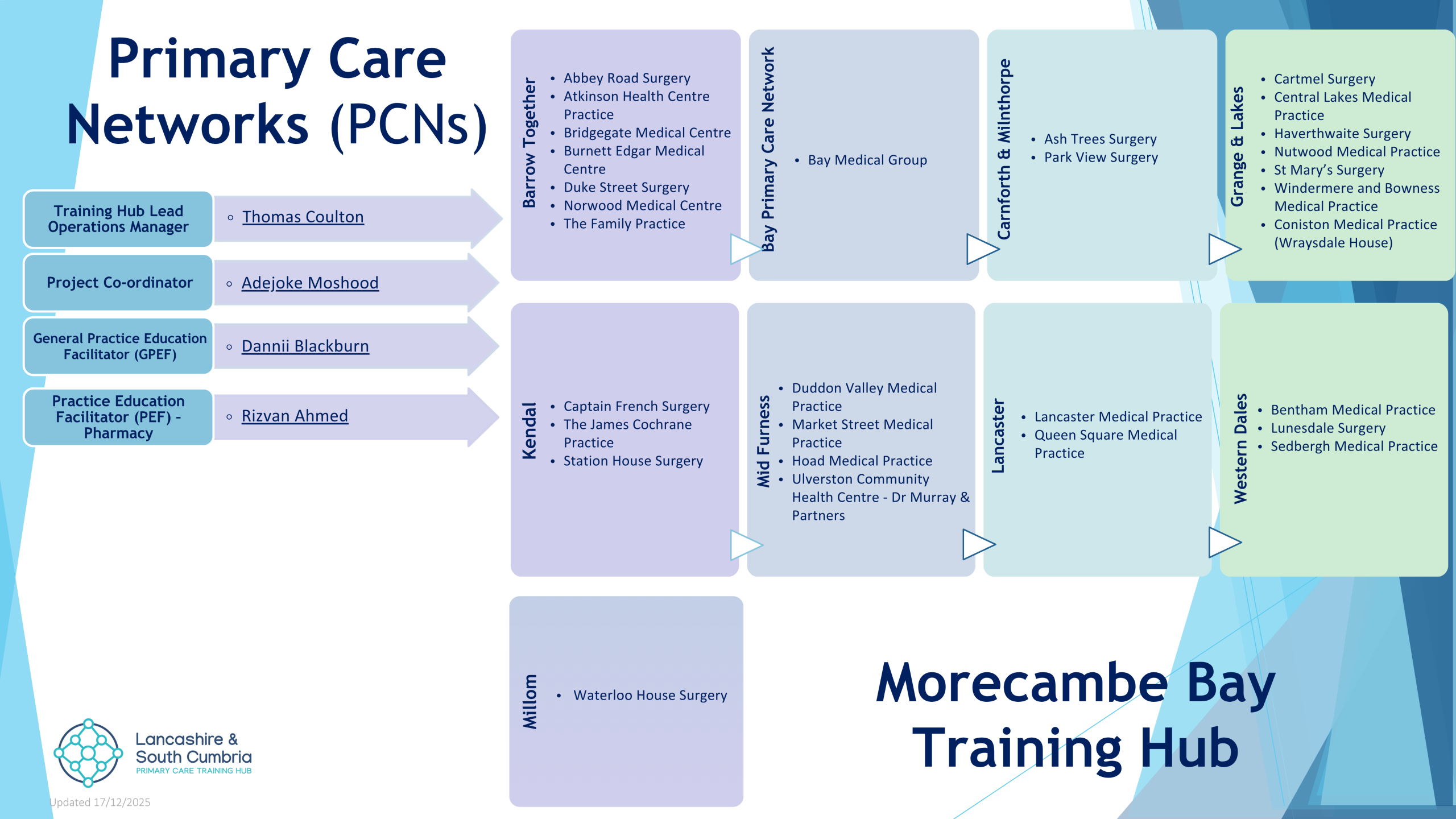
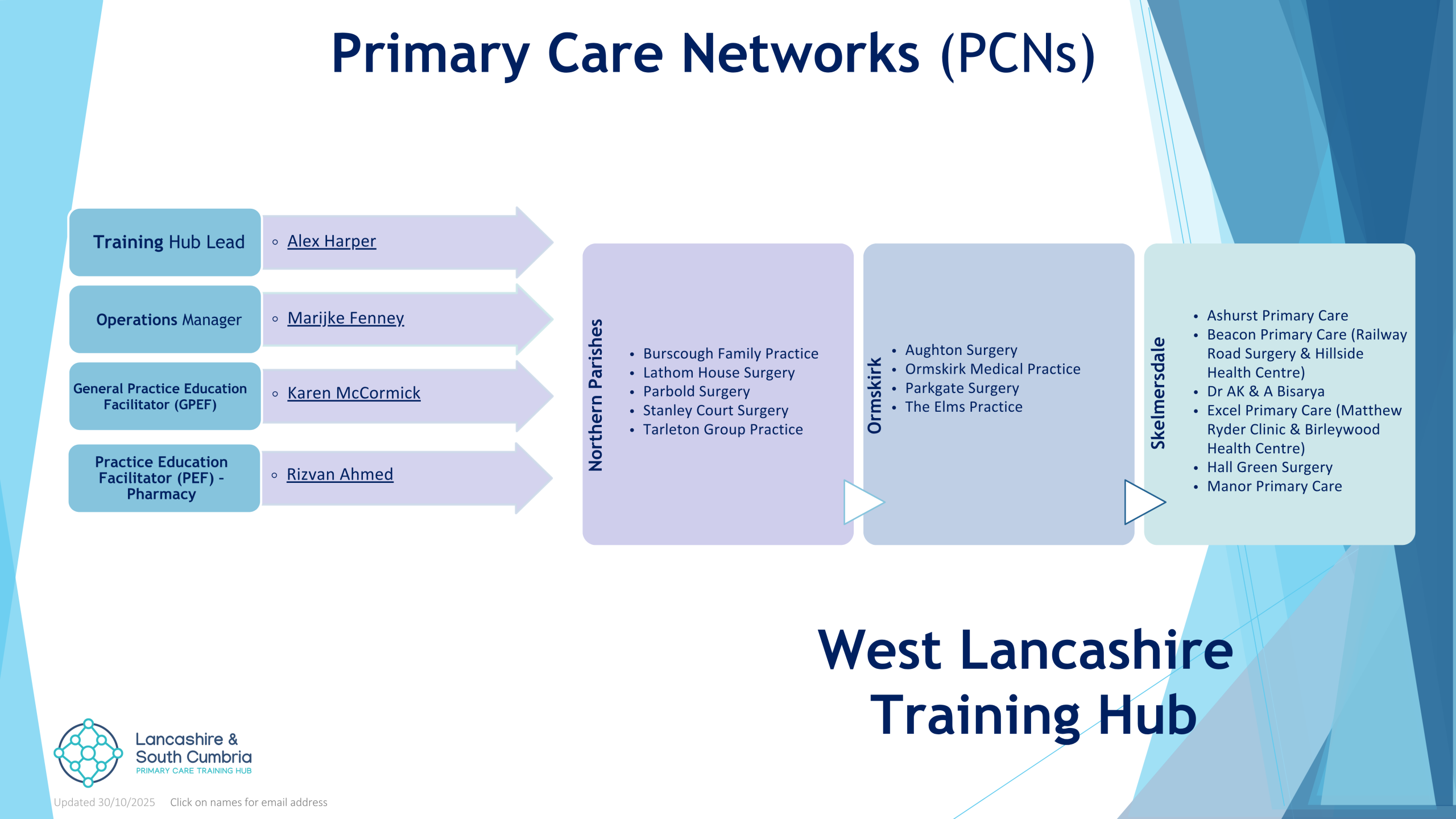
Working in partnership with the Five Training Hub Localities;
Providing support to each Locality Training hub, Leads, Operation Managers, General Practice Education Facilitators (GPEFs), Trainee Nursing Associate Practice Education Facilitators (TNA PEFs), and organisation Practice Education Facilitators (PEFs) in expanding clinical placements and ensuring the provisions are of a high-quality multi-professional learning environment across the sectors.
Meet our Team
General Practice Education Facilitators (GPEFs)







Digital Project Support Officer

Administrator

Rhianna Whitaker
Administrator